

Teacher Trainer Compass
Core Practice
A small-group programme for experienced ESL teachers who are stepping into teacher training and want a clearer, more grounded way of approaching the role.
You’ll:
Develop practical observation skills
Handle feedback conversations with more confidence
Grow into your role as a teacher trainer
Does this feel familiar?
You’re already supporting other teachers. You observe lessons, give feedback, sometimes have informal development conversations.
But in those moments, it doesn’t always feel as clear as you’d like.
· You’re not always sure what to focus on during observations
· You find yourself wondering whether your feedback is actually helpful
· You replay conversations afterwards, thinking about what you could have said differently
· At times, you hold back to avoid discomfort, especially with more experienced teachers
· And you’re not always sure where you stand in all of this — colleague, mentor, something in between
You care about supporting teacher development. That part isn’t the issue. But without a way of approaching it, it can start to feel like you’re piecing things together as you go.
After a while, that catches up with you.
Observations feel heavier than they need to be. Feedback conversations carry more weight than they should. And instead of settling into the role, it can start to feel less and less certain.

By the end of the programme, you will:
Have a clearer sense of what your role actually is, what sits within it, and where your boundaries are
Feel more settled in your position, even if you are still relatively new to it
Look at teacher development differently, as something that builds over time rather than just feedback after a lesson
Know what to look for in a lesson, how to decide what matters, and how to notice patterns rather than getting stuck on individual moments
Handle feedback conversations more easily, with a structure that still feels natural
Talk about both strengths and areas for development without over-softening or avoiding what needs to be said
Feel more confident navigating more delicate situations, with something to fall back on
This is not about collecting ideas. You will be working with them in your own context as you go, adjusting them so they actually fit your setting.
The Shift You Can Expect
At the beginning, many participants find themselves second-guessing what they say, unsure what really matters in a lesson, and hesitating in feedback conversations.
That starts to shift quite quickly.
You begin to approach observations with more focus. You know what you’re looking for, and you’re clearer on why it matters. Feedback conversations feel more thought-through, less reactive, and more useful for the teacher in front of you.
You’re not trying to come up with the “right” thing to say on the spot anymore. You have something to lean on.
And that change doesn’t go unnoticed. Teachers start to experience your input differently. It feels clearer, more considered, and easier to act on.
Live sessions
There are 8 live sessions, each lasting 90 minutes, running every other week. The group stays small.
The pace is intentional. You have space between sessions to try things out, think through real situations, and come back with something concrete to work on.
How the programme works

Learning in your own context
It’s not separate from your work. It sits alongside it.

Support and guidance
You’ll be supported throughout the programme, with opportunities to reflect on your experiences, ask questions, and develop your approach with more clarity and confidence.

Peer group
You’ll also be part of a small group of peers in similar roles, so you can share what’s actually happening, not just talk in theory.

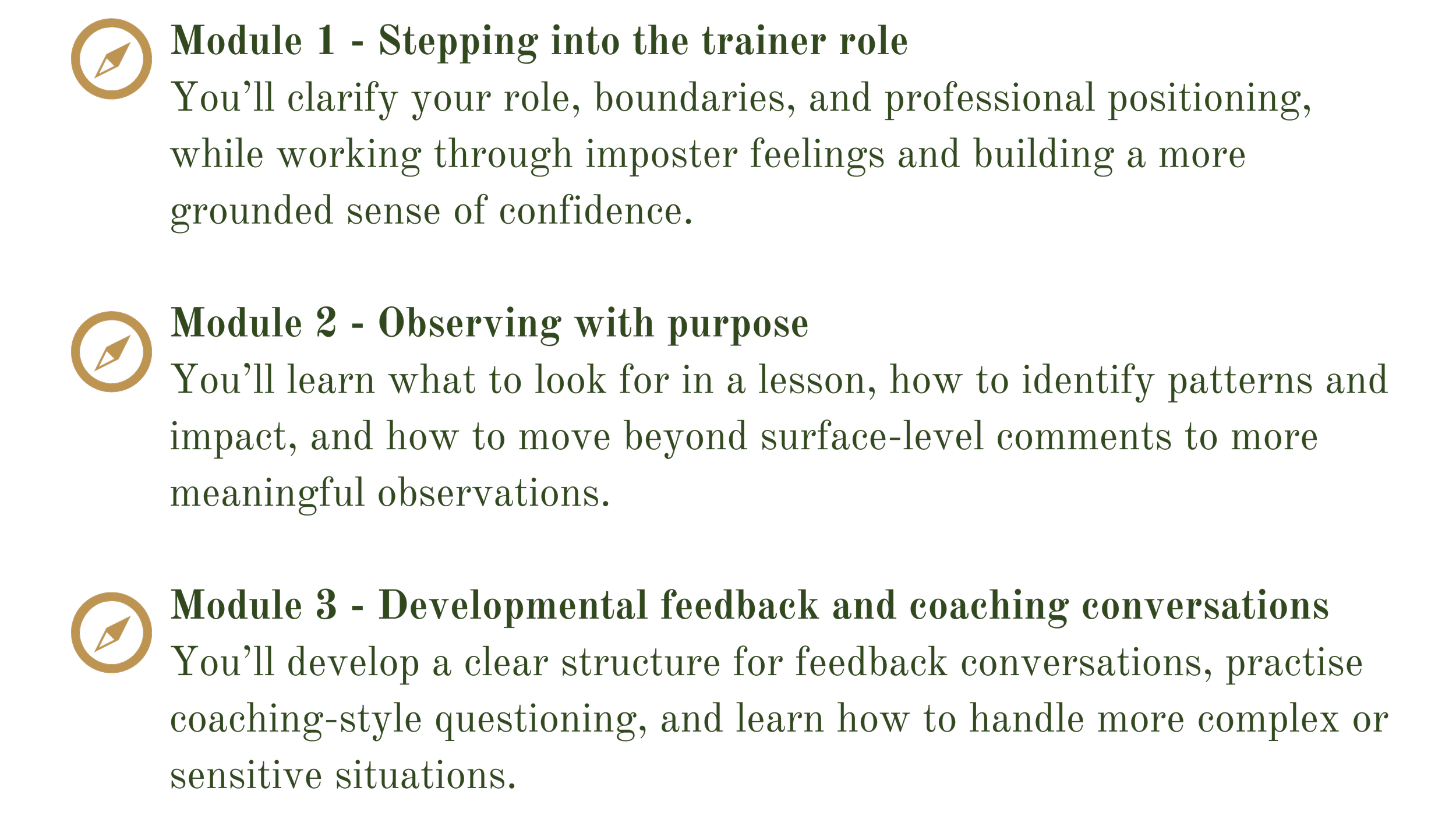
Throughout the programme, you’ll develop the key skills and approaches needed to grow into your teacher trainer role.
What happens after this?
I recommend that you choose to continue with Teacher Trainer Compass: Expanding Practice.
That part looks more at CPD, longer-term teacher development, and how to build ways of working that are sustainable over time.
There’s no expectation to continue. You can decide later whether it feels like the right next step.

About me
I’ve spent over 10 years working in ELT, including the past 5 years supporting and training teachers in language school contexts. I understand the shift from being an experienced teacher to stepping into a role where you’re guiding the development of others, and how unclear that can feel at times. I’ve seen how common it is to take on these responsibilities without a clear structure or support, and how much uncertainty that can bring, even for experienced professionals.
In my current work with a language school, this approach has helped create a culture of trust, where observation is seen as part of development rather than evaluation. My approach focuses on practical, thoughtful development. Not just what to do, but how to support teachers in a way that is clear, respectful, and genuinely leads to growth. Through this programme, I bring together practical frameworks, real experience, and a reflective approach to help you grow into your role with more clarity and confidence.

Beta programme: €295
8 sessions over 4 months
Live sessions every other Saturday at 4:00pm (CET)
Small group format (maximum 5 participants)
Ongoing support between sessions
This will be a small, focused group, with a maximum of five participants.
That means you’ll get a high level of individual attention, space to bring your own situations, and more direct support throughout the programme.
Future cohorts will remain small, but they won’t offer this same level of individual focus.
The content and structure are fully developed, but as this is the first time I’m running the programme in this format, I’ll be paying close attention to how it works in practice and making small adjustments where needed.
In return for your feedback and reflections as you go through the programme, you’re offered a reduced price for this first round.
-
I’m a DELTA-qualified teacher and have been working in ELT for over 10 years, including the past 5 years supporting and training teachers in language school contexts.
In my current role, I work closely with teachers through observation, feedback, and CPD. Over time, this has helped build a culture where observation is part of development rather than something evaluative.
The way I work comes from real situations. The frameworks you’ll see in the programme aren’t theoretical models. They’ve been shaped through practice, and are designed to be used in your own context.
-
No.
This is for teachers who are already supporting others in some way, whether that’s formal or not.
You might be observing lessons, giving feedback, or gradually taking on more responsibility in your team. If you’re starting to move into this role and want a clearer way of approaching it, the programme will meet you there.
-
Yes.
You don’t need to start from scratch to benefit from this. Most people who join are already doing these things.
What tends to be missing is a way of making sense of it. Not just what to do, but how to approach it so that it actually supports development.
That’s where the work sits.
-
The programme is designed to sit alongside your existing work, not add another layer on top.
Sessions run every other week, and most of the work happens through what you’re already doing. You’ll be trying things out in your day-to-day context, then bringing that back into the sessions.
The pace is steady, with space to think and adjust as you go.
-
A lot of participants choose to invest in this themselves, especially when they want to feel more settled and confident in the role.
The work you do during the programme connects directly to what you’re already doing, so it tends to have an immediate impact.
If it’s relevant, you can also use the programme outline to have a conversation with your employer about support.
-
We spend time looking at how these conversations work in practice. How to structure them, how to say what needs to be said without over-softening it, and how to handle moments that feel more delicate.
You’ll also be working with your own real situations, so you’re not just thinking about it in theory.
-
That’s a very normal part of the process. You’ll have space to reflect on real situations, think through conversations in advance, and adjust your approach with support as you go.
-
This comes up a lot.
We look at how to approach these situations in a way that still feels respectful, but doesn’t avoid the conversation. That includes how you position yourself, how you frame things, and how you keep the focus on development.
It’s not about having a perfect script. It’s about having something to lean on when it matters.
-
It’s designed specifically for teachers who are in that in-between space, already supporting others but not always feeling fully sure of how to approach it.
The focus isn’t on theory on its own. It’s on working with real situations, in your own context, and having the space to reflect on what’s actually happening.
The small group also matters. You’re working alongside people who are dealing with similar things, which changes the kind of conversations you can have.
-
I recommend that you continue with Teacher Trainer Compass: Expanding Practice.
That part looks more at CPD, longer-term teacher development, and how to build ways of working that are sustainable over time.
There’s no expectation to continue. You can decide later whether it feels like the right next step.
Frequently Asked Questions



Working with Aurore has really changed the way I think about teaching. She consistently challenged me to look at my lessons from different perspectives, which helped me realise how important it is to stay flexible and keep refining my approach.
For example, during one lesson I planned, she asked me to rethink how I was staging a speaking activity — instead of jumping straight in, she encouraged me to build in clearer scaffolding and give students more structured preparation time. I adjusted the activity by adding guided prompts and modelling, and the difference in student engagement and confidence was immediate.
Her feedback was always thoughtful and practical, and it pushed me to make adjustments to my methodology that have made a real difference in my classroom. I feel much more aware and intentional in my teaching now, and that’s been incredibly valuable.
Luke Wyles, Academic English Teacher, China